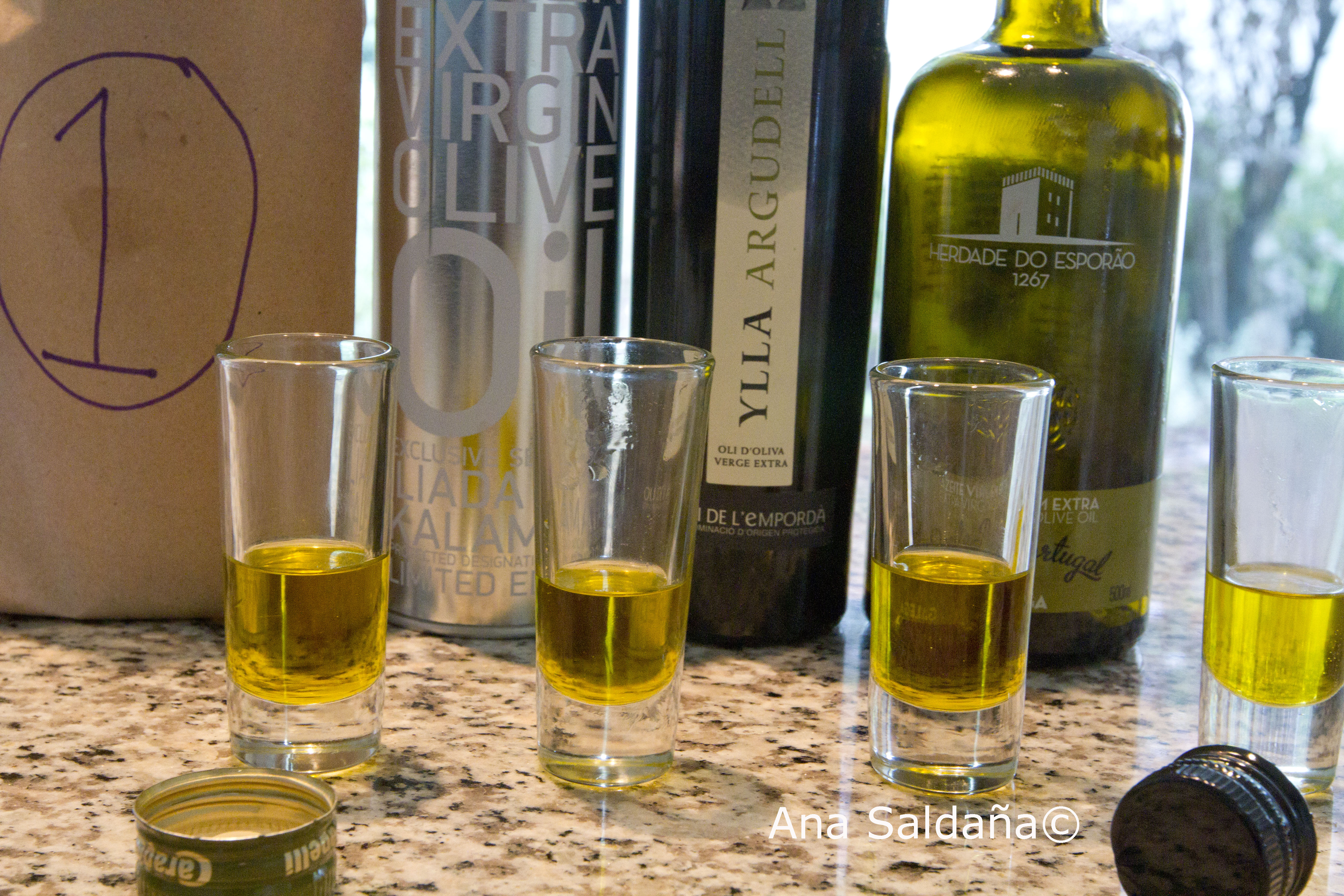
Olive Oils are tricky. If you look at the labels, there is: extra-virgin, virgin and plain olive oil. So what is the difference? Well, extra virgin as you know is the higher quality oil. What does this mean? That it has a naturally low-level of free oleic acid. In olive oils, the lower the level, the better. Still, there are some producers who include some good quality oil and then mix it with low quality oil which has undergone a chemical process to remove or cut the acidity, labelling the oil as extra virgin since it does contain extra virgin oil.
Here is where your taste buds come to the rescue. Cheap olive oils usually feel greasy and they are sweeter and have very little taste. Contrary to what you would imagine, the low-level of oleic acid, does not mean they are sweet, on the contrary, good olive oil should have fruity and nutty aroma. I love the olive oils that have a bite to them, and you can just feel them at the back of your throat.
So what can we do? I have different oils, for different uses at home. I use the commercial extra virgin olive oil for cooking, since it has a higher smoking point ( the temperature at which a cooking fat or oil begins to break down) and I’ll have some special olive oil for my salad and for drizzling over food. For my special oil I usually look for olive oils that come from a specific region, that have been handpicked and that name the specific variety of olive it is made from. My personal favorites are Greek and Tuscan olive oils.
One thing you should always keep in mind is that olive oil is perishable. Olive oil should be consumed within a year after it was pressed (you can look at the date on the bottle). Also, you should never refrigerate olive oil and you should always store it in a dark cupboard, keeping it away from the heat.
Finding your favorite olive oil is fun. Maybe you can get your friends together for an olive oil tasting and have them bring different olive oils within a selected price range. I suggest you get 3 very good quality oils and one bottle of a cheap commercial brand. There is a whole protocol that real olive oil tasters should follow, but let me share a less formal approach that will work for the home tasting.
What do you need for an olive oil tasting?
4 glasses per person (I usually use my tequila glasses for this)
Slices of Granny Smith Apples (for refreshing the palate between each oil tasting)
Pencil and paper so that you can jot down your impressions
Enough brown paper bag and rubber band to cover the olive oil so that you can do a blind tasting
4 different types of olive oil
Before your guests arrive, set the table with 4 glasses for each guest, a notepad and pencil and a small plate for the apples. Cover the bottles of olive oil with the brown paper bag securing it with a rubber band and label them with a number (guests should not know what oil they are tasting). When its time to begin the tasting you should pour about 1 tablespoon of the selected oil in each glass, making sure you follow the order on the label of the bag (1, 2, 3, 4) serving them all at once. In order to taste the oil they should be at room temperature, so if it feels cool, warm it up with your hands in the glass before tasting it. When it is time to taste, you should hold the glass and use your other hand to cover it while you swirl it (this will release the aroma). Then you have to inhale and think whether the smell is strong or mild and if there are any aromas that you are reminded of. Make sure to jot down your what you are perceiving. Then swallow the oil, noticing if it leaves a stinging sensation or the feeling on your palate.
In a good oil you should find a fruity taste of the olives, it could feel bitter at the back of the tongue and it could be pungent (which is usually described as a spiciness in your throat).
Any flavors reminding you of fusty, musty, muddy sediment, winey-vinegary, rancid or burnt mean this is not a good oil. There is a great list published by the Olive Oil Tasting Source that talks a bit more about these aromas.
By the end of the evening I am sure, you will have found your favorite oil and will have noticed differences between the oils you tasted.
And the oils that were not so popular, just use them for cooking!


 Dash of Spice and Life
Trackbacks/Pingbacks
[…] home, I never buy dressings. I always have a good balsamic vinegar and extra virgin olive oil on hand. When I prepare salads, my favorite dressing is just a drizzle of each, with some freshly […]